Immune System SeriesThe Immune System and the Nervous System
A new field of research, known as psychoneuroimmunology, is exploring how the immune system and the brain may interact to influence health. For years stress has been suspected of increasing susceptibility to various infectious diseases or cancer. Now evidence is mounting that the immune system and the nervous system may be inextricably interconnected.
Research has shown that a wide range of stresses, from losing a spouse to facing a tough examination, can deplete immune resources, causing levels of B and T cells to drop, natural killer cells to become less responsive, and fewer IgA antibodies to be secreted in the saliva.
Biological links between the immune system and the central nervous system exist at several levels. One well-known pathway involves the adrenal glands, which, in response to stress messages from the brain, release corticosteroid hormones into the blood. In addition to helping a person respond to emergencies by mobilizing the body's energy reserves, these "stress hormones" decrease antibodies and reduce lymphocytes in both number and strength.
More recently, it has become apparent that hormones and neuropeptides (hormone-like chemicals released by nerve cells), which convey messages to other cells of the nervous system and organs throughout the body, also "speak" to cells of the immune system. Macrophages and T cells carry receptors for certain neuropeptides; natural killer cells, too, respond to them. Even more surprising, some macrophages and activated lymphocytes actually manufacture typical neuropeptides. At the same time, some lymphokines, secreted by activated lymphocytes such as interferon and the interleukins, can transmit information to the nervous system. Hormones produced by the thymus, too, act on cells in the brain.
In addition, the brain may directly influence the immune system by sending messages down nerve cells. Networks of nerve fibers have been found that connect to the thymus gland, spleen, lymph nodes, and bone marrow. Moreover, experiments show that immune function can be altered by actions that destroy specific brain areas.
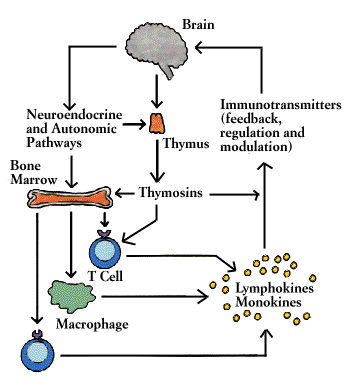
The image that is emerging is of closely interlocked systems facilitating a two-way flow of information, primarily through the language of hormones. Immune cells, it has been suggested, may function in a sensory capacity, detecting the arrival of foreign invaders and relaying chemical signals to alert the brain. The brain, for its part, may send signals that guide the traffic of cells through the lymphoid organs.